

Lung Cancer and Radon
Radon is the leading cause of lung cancer among Canadians who do not smoke. Risk increases as concentrations rise and exposure continues over time.
You can't see radon, but you can understand it, measure it, and do something about it. A clear path to a healthier home starts here.
Radon is a naturally occurring radioactive gas. It has no smell or colour, and it can build up indoors without anyone noticing. The only way to know your level is to test.
See how radon enters a homeRadon is the leading cause of lung cancer among Canadians who do not smoke. Risk increases as concentrations rise and exposure continues over time.
No radon level is entirely risk-free. Health Canada recommends corrective action at or above 200 Bq/m³, and lower long-term exposure means lower risk.
About one in six Alberta homes is estimated to be at or above the Canadian action guideline. Only testing tells you what is happening in yours.
A long-term test takes about three months. Health Canada specifies at least 91 days for guideline comparison. Colder months often bring higher readings.
Based on Health Canada guidance and the 2024 Cross-Canada Radon Survey.
In colder weather, windows and doors are generally closed, which reduces ventilation. As warm air rises through the home, pressure differences can also draw more radon-containing soil gas through foundation openings. Every home is different, so long-term testing matters.
Radon exposure adds up over time. Testing gives you a starting point, and the right mitigation approach can help reduce soil gas before it enters your living spaces.
Start a conversation ↗See where radon comes from, how it enters, and how a mitigation system redirects it.
Radon forms naturally in soil and rock. The gas can move through the ground and collect beneath a home's foundation.
Cracks in the concrete, gaps around service pipes and other openings can allow soil gas to enter your living space.
An active mitigation system uses a continuously operating fan and sealed piping to draw soil gas from beneath the foundation and safely discharge it outdoors.
Explore mitigation approaches ↗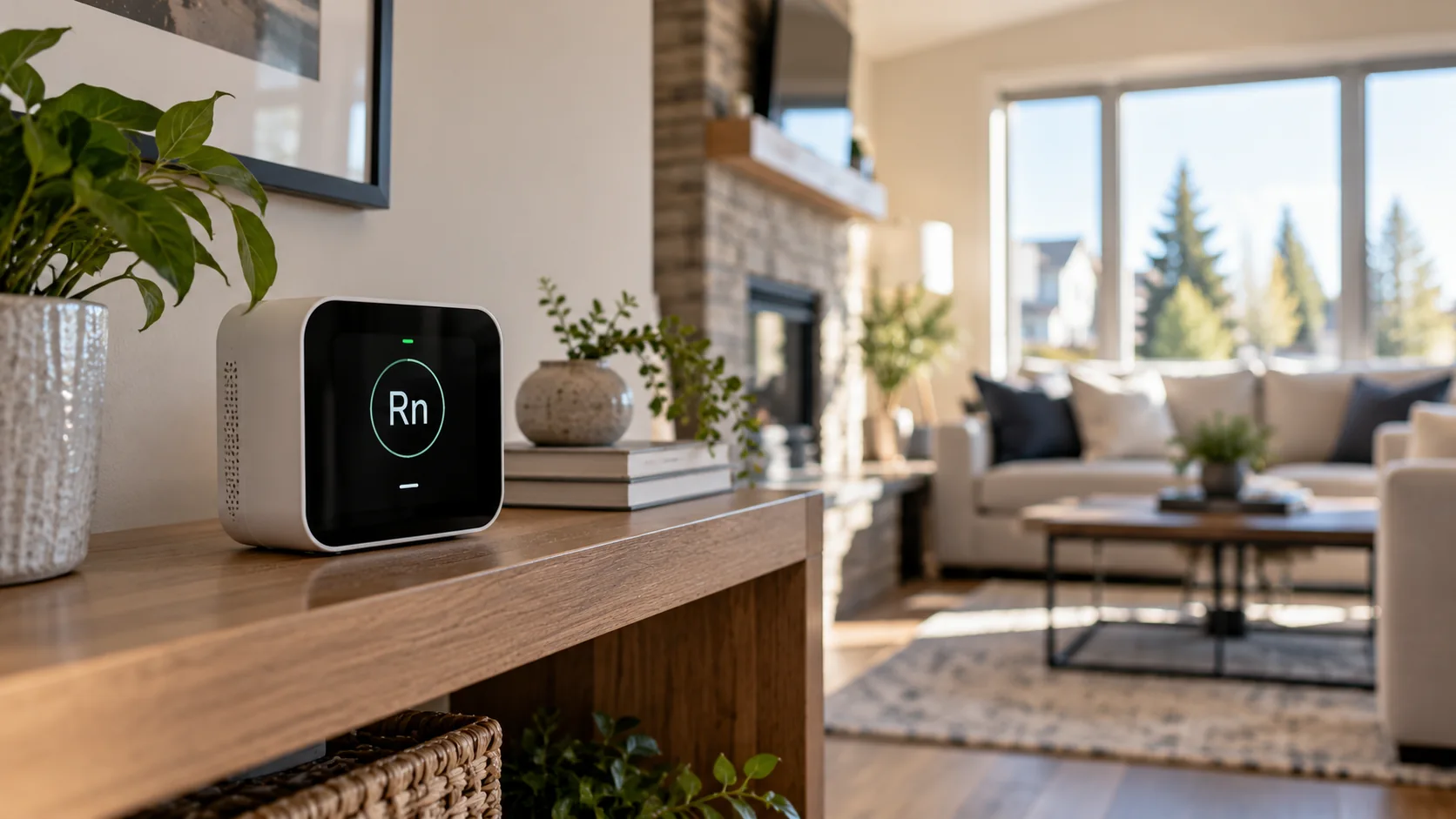
We help homeowners understand long-term testing, detector placement and what their results mean. Radon levels change from day to day, so a single reading rarely tells the whole story.
Ask about testing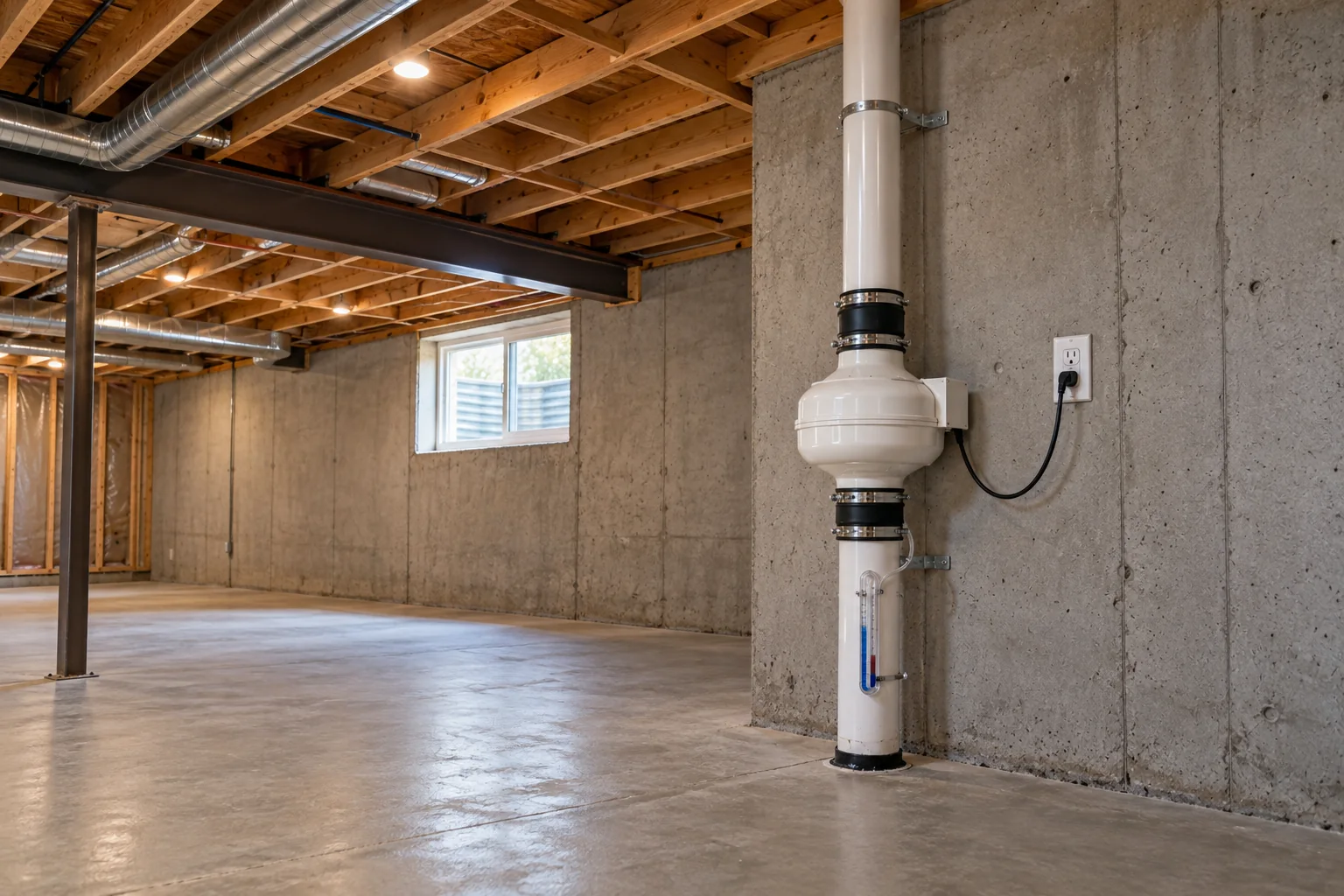
We assess the foundation, determine a practical suction point and install the fan and sealed vent piping needed to move soil gas safely outdoors.
Explore mitigationTwo common methods. The right one depends on your foundation and the connections available.
Newer Alberta homes may already have a capped radon rough-in following building-code changes introduced in 2015. We can check whether yours is present and suitable to use.
Where a suitable rough-in exists, we connect a continuously operating radon fan close to the pipe and route sealed venting through the basement. Sump and other potential entry points can also be sealed.
Talk about your home

Already have a reading? Explore how a long-term result compares with Canada's action guideline and why lower levels are better.
A long-term result below 200 Bq/m³ is below the Canadian action guideline. Lower is still better.
Clear steps. Good communication. A solution matched to the property.
Tell us about your property, any radon readings you already have and what you'd like to understand.
A long-term test provides the clearest starting point. We can explain device placement and how to interpret the results.
If your home needs mitigation, we assess the foundation, possible suction locations and an appropriate vent route.
After installation, homeowners arrange follow-up long-term testing to confirm the reduction.
Tell us about the property and whether you already have a reading. We'll help identify the next sensible step.
Start the conversation ↗Local service, straightforward communication and practical radon solutions for Edmonton and surrounding communities.
“Everything was explained clearly, and the installation was completed with care. The finished work looks clean and professional.”
“They took time to answer my questions and explain the options. I appreciated the straightforward approach from start to finish.”
“The team was easy to work with, paid attention to the details and left the area tidy. I would be happy to recommend them.”
Moe is the first point of contact for radon questions and test results. He helps homeowners understand what the numbers mean, reviews the building conditions and develops a clear, practical plan for reducing exposure.
Reiner brings years of hands-on installation experience to each home. He focuses on tidy routing, secure connections and careful finishing so each system fits the property and works as intended.
We work with recognized Canadian radon guidance and pay attention to the installation details that matter.

Answers to the questions Edmonton homeowners ask most often.
Ask us something else ↗Radon is a radioactive gas produced naturally as uranium breaks down in soil and rock. It can enter buildings through openings in their foundations. Because it has no colour, smell or taste, testing is the only way to know your indoor level.
Health Canada recommends a long-term test of at least three months (91 days or longer), ideally including the heating season. Indoor levels often rise in colder months, so a longer test gives a more representative result.
Health Canada recommends corrective action when a long-term average is 200 Bq/m³ or higher. The lower your radon exposure, the better. You can also ask about reducing levels below the guideline.
A common approach uses a fan and sealed pipe to collect soil gas beneath the building and direct it outdoors. Routing and exhaust placement vary by house. A follow-up measurement is important to confirm performance.
No. Radon often enters from the ground, but it can affect occupied spaces on other floors as well. Test the lowest level of your home that is regularly occupied.
Yes. Homeowners arrange a long-term post-installation test to confirm that levels have dropped. Follow-up measurement is not included in our mitigation installation service.
Many typical residential systems can be completed in about a day, but the actual schedule depends on access, site conditions, foundation and the proposed vent route.
We can discuss radon work for commercial buildings, multi-unit properties, new construction and existing systems. Contact us with the building details and we can review the scope.
Have a radon reading? Need to understand testing or mitigation options? A conversation is a good place to start.
PREFER TO CALL?780-818-9745Prefer writing? Prepare an email with your details below.


